
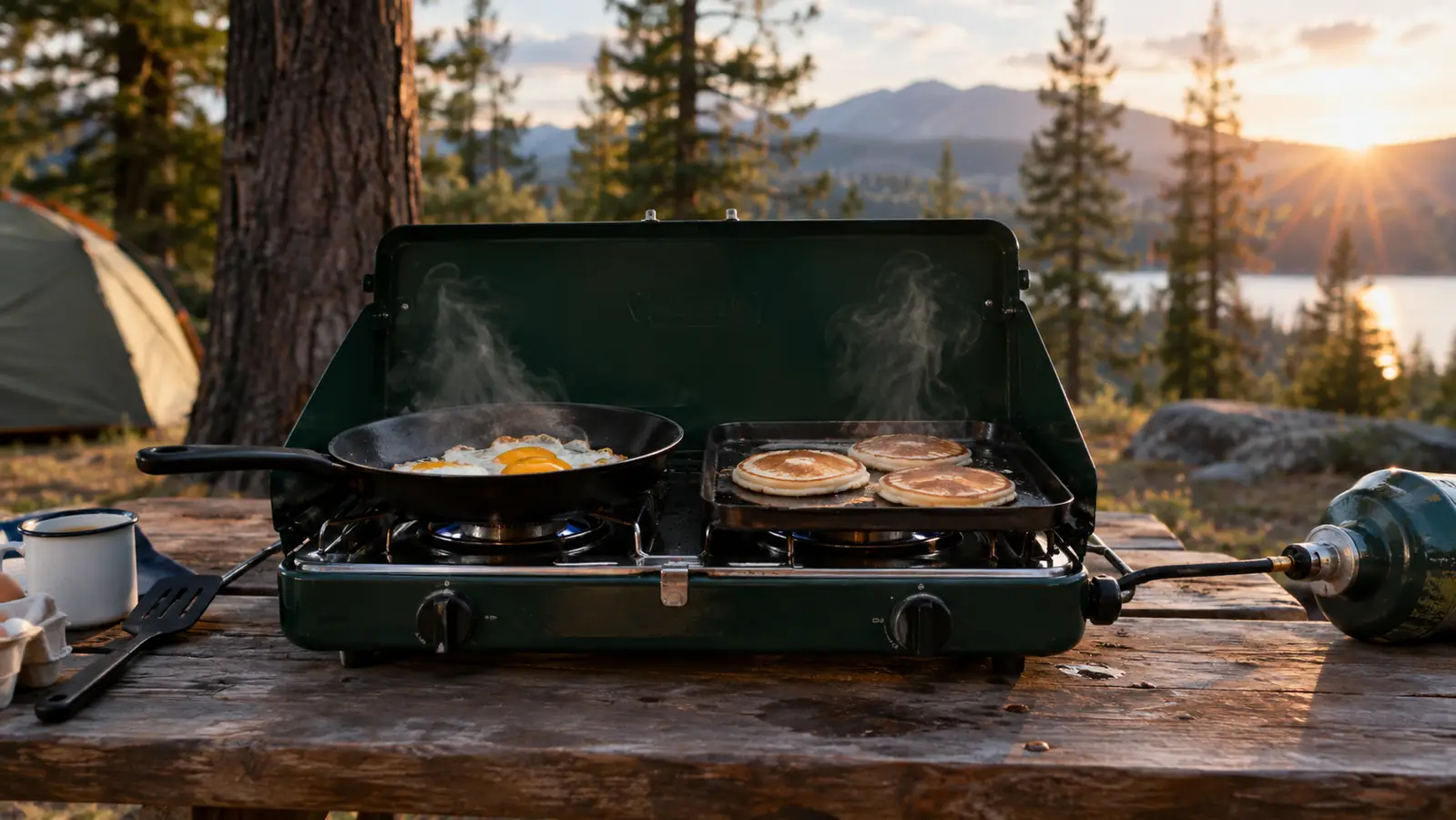
For years, breakfast at our campsite was a compromise. I would boil water for instant oatmeal while Ray stood over a little single-burner stove flipping one pancake at a time. The eggs, when there were eggs, went cold on the plate while the pancakes caught up. Nobody starved. But nobody sat down to a real meal either. We ate standing up, in shifts, and the whole production took twice as long as it should have.
The problem was never the cooking. It was the stove. Most two-burner camp stoves put out about 10,000 BTUs per burner, and one burner is usually a simmer burner that will not get hot enough to crisp bacon. You cook one thing, move it aside, cook the next thing, and by the time the second thing is done the first thing is cold. The fix is a stove with real output on both burners, which is exactly what the Camp Chef Explorer 2-burner is. I have used mine on about thirty camping mornings over two seasons, and this is the sequence that gets a full breakfast, eggs, bacon and pancakes, onto the table at the same time.
The turning point was a stove with two burners that could both get properly hot. Not just hot enough to boil water, but hot enough to sear bacon and hold a gentle simmer at the same time. That single change did more for our camp mornings than any recipe, pan, or gadget I have bought since.
Two burners that can actually keep up with breakfast
The Camp Chef Explorer puts out 30,000 BTUs per burner, enough to run a griddle and a pan at the same time. It is the stove that made the sit-down breakfast possible at our campsite.
Amazon Check Today's Price on Amazon →Why the Stove Matters More Than the Recipe
Every camp breakfast guide you read will tell you to prep the night before, mix the dry ingredients at home, and keep things simple. That advice is fine as far as it goes. But it is aimed at people cooking on a stove that cannot do more than one thing at a time. When the stove is the bottleneck, the recipe has to work around it.
A two-burner stove with real output on both burners removes the bottleneck. You are not choosing between bacon and pancakes. You are cooking both, plus the eggs, plus the coffee, and the only limit is how much table space you have. That is why the stove is the first thing I would fix, before any of the cooking techniques.
The other thing the output buys you is forgiveness. If the bacon is taking longer than expected, you can turn the second burner down and the eggs will wait. If the pancakes are browning too fast, you can slide them to the cooler side of the griddle. A stove with heat to spare lets you make small corrections instead of starting over.
Step 1: Set up on a level table, away from the tent
The Camp Chef Explorer is a big stove, and it wants a real table. I use a folding camp table or the picnic table at the site, never the tailgate of the 4Runner, because the tailgate is rarely level and the stove slides. Set it at least ten feet from the tent, with the wind at your back or with a small wind screen on the open side.
Level matters more than people think. A griddle that tilts even slightly pools the bacon grease to one side, and the eggs run to the low edge of the pan. I check with a small level once and then leave it alone. The legs on the Explorer fold out and lock, and the stove sits solid. Once it is down, it does not move.
Wind is the other thing that ruins a camp breakfast. A gust hits the flame, the pan cools, and the eggs stop setting. I set the stove with the wind at my back, and on breezy mornings I put a small folding wind screen on the open side. The burners on the Explorer are powerful enough that a little wind does not bother them, but there is no reason to fight it.
Step 2: Preheat both burners before the food goes down
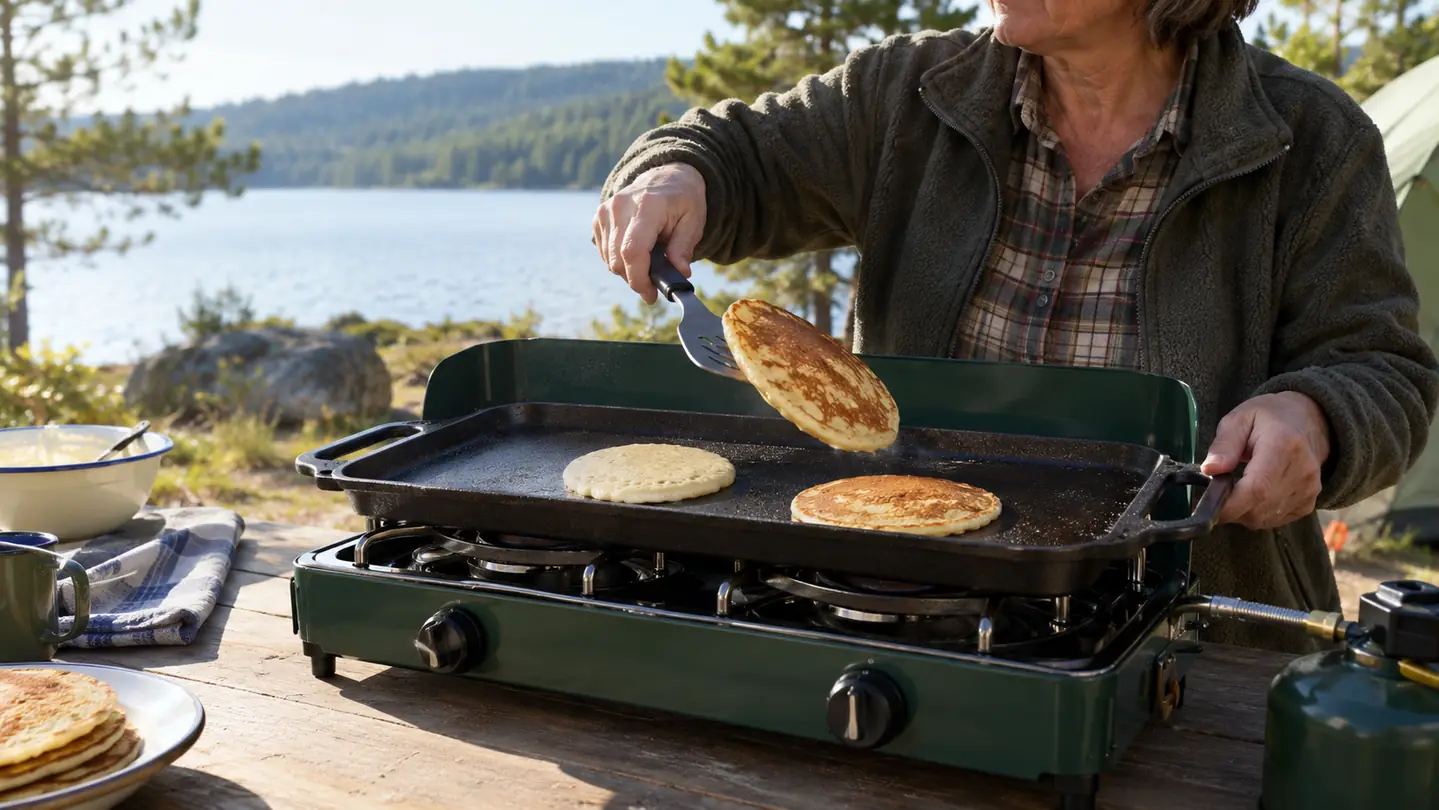
The Camp Chef Explorer's burners put out 30,000 BTUs each, which is more than most home stoves deliver on a big burner. That is the whole point of this stove, and it means you do not need to run it wide open. I turn both burners to medium and let the griddle and the pan preheat for three or four minutes while I get the bacon out of the cooler.
Preheating is what keeps the first batch of pancakes from sticking and the eggs from spreading into a thin film. A cold pan on a powerful burner heats unevenly. A warm pan on a controlled burner cooks evenly. The dials on the Camp Chef Explorer are easy to adjust with one hand, which matters when the other hand is holding a spatula.
The Explorer is rated at 60,000 total BTUs across the two burners. That is the number that matters for breakfast, because it means the second burner is not a weak afterthought. It also means the coffee water boils fast. I put the percolator on while the bacon renders, and the water is ready before the first strip is crisp.
Step 3: Cook the bacon first, and keep it warm
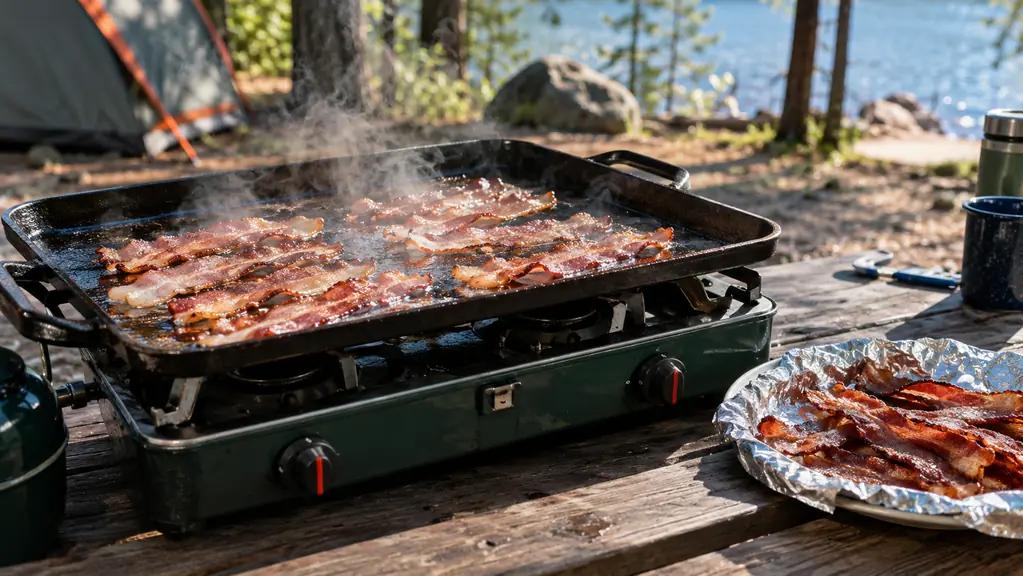
Bacon goes down first because it takes the longest and because the grease it renders becomes useful. I lay the strips on the griddle, as many as fit without overlapping, and let them cook on medium-high. Because the griddle covers both burners on the Camp Chef Explorer, I can run the whole pound at once. On the old single-burner stove, that took three batches.
While the bacon cooks, I set a plate with a sheet of foil beside the stove. As each strip finishes, it goes onto the plate and the foil gets folded over the top. That keeps it warm and, more importantly, keeps it crisp instead of steaming. The covered plate sits on the table, not on the stove, so nothing on the burners has to be moved to make room.
I keep the grease can on the table next to the stove, with the lid off, and pour as I go. At the end of breakfast, the can goes into the trash bag and the griddle gets a scrape with the spatula. A quick wipe with paper towels while the griddle is still warm, and cleanup is done before the plates hit the table.
Step 4: Run eggs and pancakes on two stations
This is the step the two-burner stove exists for. One burner keeps the griddle hot for pancakes. The other runs the pan for eggs. Both at once, both with full heat, neither one waiting on the other. It sounds obvious, but it is the thing most camp stoves cannot do because their second burner is too weak.
I mix the pancake batter while the bacon cooks, so it is ready to pour the moment the griddle is free. The eggs go into the pan on the second burner at the same time. From there it is a simple rhythm: pour three pancakes, stir the eggs, flip the pancakes, stir the eggs again. The two burners on the Explorer are close enough that you can reach both without taking a step.
I make the batter at home and carry it in a quart jar, so the only thing left at camp is to pour. If you mix it at the table, do it before the bacon goes down so the batter can rest. As the pancakes come off, I stack them on the covered plate with the bacon. They stay hot, and the stack stays soft.
Step 5: Land everything at once, then sit down
The last five minutes are about finishing together, not cooking. The coffee should already be made. I run a percolator on the stove before the bacon goes down, so by the time the eggs are set, the coffee is ready and the cups are on the table. Hash browns, if I am making them, go on the griddle right after the bacon comes off, in the bacon fat.
I put the plates out before the food is done, not after. Silverware, napkins, the bottle of syrup, the salt and pepper. When the eggs are set and the last pancake is flipped onto the stack, everything moves to the table in one trip. That is the moment the whole system pays for itself: a full breakfast, all of it hot, all of it at the same time.
After breakfast, the stove gets a few minutes to cool before it goes back in the 4Runner. The griddle gets its wipe, the grease can goes in the trash, and the plates go in the wash bin. The whole cleanup takes about ten minutes, and it is the price of eating a real meal instead of a granola bar.
What Else Helps
The stove does the heavy lifting, but a few small things make the difference between a breakfast that works and one that feels like work. A flat griddle that covers both burners is the biggest one. The Camp Chef Explorer works with a cast iron griddle that spans the two burners, which gives you one continuous cooking surface for bacon and pancakes. I use that griddle more than I use the pans.
A long spatula, a covered plate or a sheet of foil, a grease can, and a percolator round out the kit. Paper towels live on the table, not in the bin. A small cutting board gives you a place to set the spatula and the tongs between uses. None of it is fancy. All of it gets used every trip.
On the coffee: a percolator is the lowest-fuss way to make real coffee at camp. It sits on the stove, it does not need filters or pour-over technique, and it makes enough for two cups plus a refill. I set it on the second burner before the eggs go in, and it is done by the time the plates are out.
The first morning I ran bacon on one burner and pancakes on the other, we sat down to a full breakfast in about twenty minutes, all of it hot at the same time.
The Camp Chef Explorer is not a small stove and it is not a light one. It is a piece of gear you buy once and use for years, which is why I have been happy to keep it in the back of the 4Runner all season instead of packing it around. If you car camp the way we do, out of bins and coolers, with a real table at the site, it changes what breakfast looks like.
If you are still making camp breakfast one item at a time on a stove that cannot hold a simmer and a sear at once, that is the thing to fix. Not the recipes, not the pans, not your timing. The stove.
This is not the stove for a backpacker who carries everything on their back. It is heavy, it is wide, and it needs a table. But for car camping, which is what we do, the weight lives in the back of the 4Runner and the width is exactly what makes a real breakfast possible. That trade has been worth it on every single trip.
Make breakfast the best part of the morning at camp
The Camp Chef Explorer 2-burner has the output to cook bacon, eggs, and pancakes at the same time, with enough heat left over for the coffee. It has held up through two seasons of weekend trips and one longer fall trip.
Amazon Check Today's Price on Amazon →