
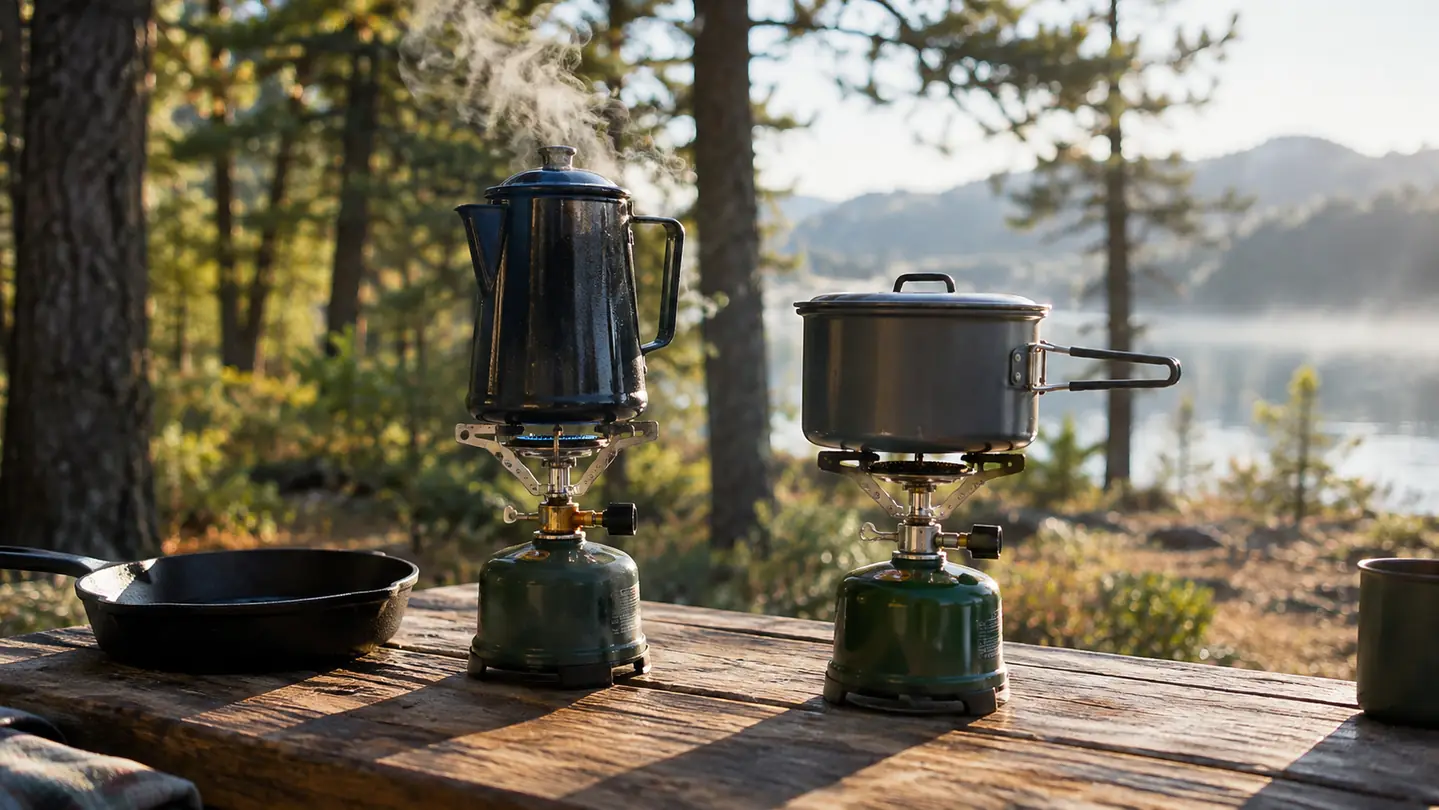
I have owned the Camp Chef Explorer for four seasons and the Coleman Triton for two, and I have cooked enough campground meals on both to have opinions instead of impressions. If you feed four to six people, boil big pots of water, or run a cast iron griddle for a crowd, the Camp Chef Explorer is the better stove, full stop. If you want something light enough to lift into a storage bin and quick to set up for two-person dinners, the Coleman Triton is the smarter buy and it costs a good deal less.
Both are reliable two-burner propane stoves from brands that have been in camping gear for decades. The real difference is not quality, it is weight and heat. Camp Chef builds a stove that cooks like a kitchen range, and Coleman builds one that packs like a suitcase. The right choice depends on how you camp, so let me walk you through exactly where each one earns its spot in the back of a 4Runner.
| Camp Chef Explorer | Coleman Triton | |
|---|---|---|
| Heat output | 60,000 total BTUs, burns hot enough for big pots and full griddles | 22,000 total BTUs, plenty for standard two-burner cooking |
| Weight | About 25 pounds, a base-camp piece of gear | Roughly 12 pounds, easy to lift one-handed |
| Cooking surface | Fits a 12-inch pan and a 10-inch pan side by side, or a full griddle | Fits 10-inch pans comfortably, good for two |
| Packed size | Bulky, takes real cargo space in an SUV | Folds flat, slips behind a seat or under a bin |
| Price | Higher up-front cost | Budget-friendly, the affordable choice |
| Wind resistance | Large fold-down windscreens, holds flame on exposed sites | Built-in wind guards, fine for protected campsites |
| Setup | Unfold legs, attach regulator hose, connect tank | Open case, screw in fuel bottle, light |
| Best for | Group meals, big pots, cast iron griddle cooking | Quick two-person dinners, trailhead breakfasts |
How I Tested Both Stoves
I live in Flagstaff, Arizona, and my husband Ray and I get out about fifteen weekends a year, mostly northern Arizona, southern Utah, and the eastern Sierra. We car camp out of plastic storage bins in the back of our 2016 4Runner, and we cook real meals, not just boil water. I have used the Camp Chef Explorer for everything from a turkey cooked in a big pot to a full griddle breakfast for six. The Coleman Triton has been my quick-meal stove, the one I grab when it is just the two of us and I want coffee and eggs without a production.
My right knee is a problem from a fall on the Kachina Trail, so how far I have to carry something and how much it weighs matters to me more than it used to. That changed how I think about both of these stoves. The Camp Chef Explorer is heavy, about 25 pounds, and it does not want to be carried far. The Coleman Triton is a little over half that weight and it folds flat. I have carried both from the truck to a picnic table, and I can tell you the difference in my knee is real.
I tested both in the same conditions over two summers: exposed ridgelines where wind comes up at dusk, protected campsites in the pines, and a few rainy mornings. I timed how long it took to get water boiling, how steady the flame held in wind, and how easy each stove was to set up and pack away with cold hands.
One thing I did not expect is how much the weight of a stove matters when you are not the one who packs. Ray carries the tent and the cooler, and I carry the bins of kitchen gear. The Camp Chef Explorer lives in my bin, and on trips where the site is a long walk from the truck, I feel every pound. The Coleman folds flat enough to ride in the same bin without taking up a third of it. That is not a spec, it is just what happens when you live out of bins for a weekend.
Where Camp Chef Explorer Wins
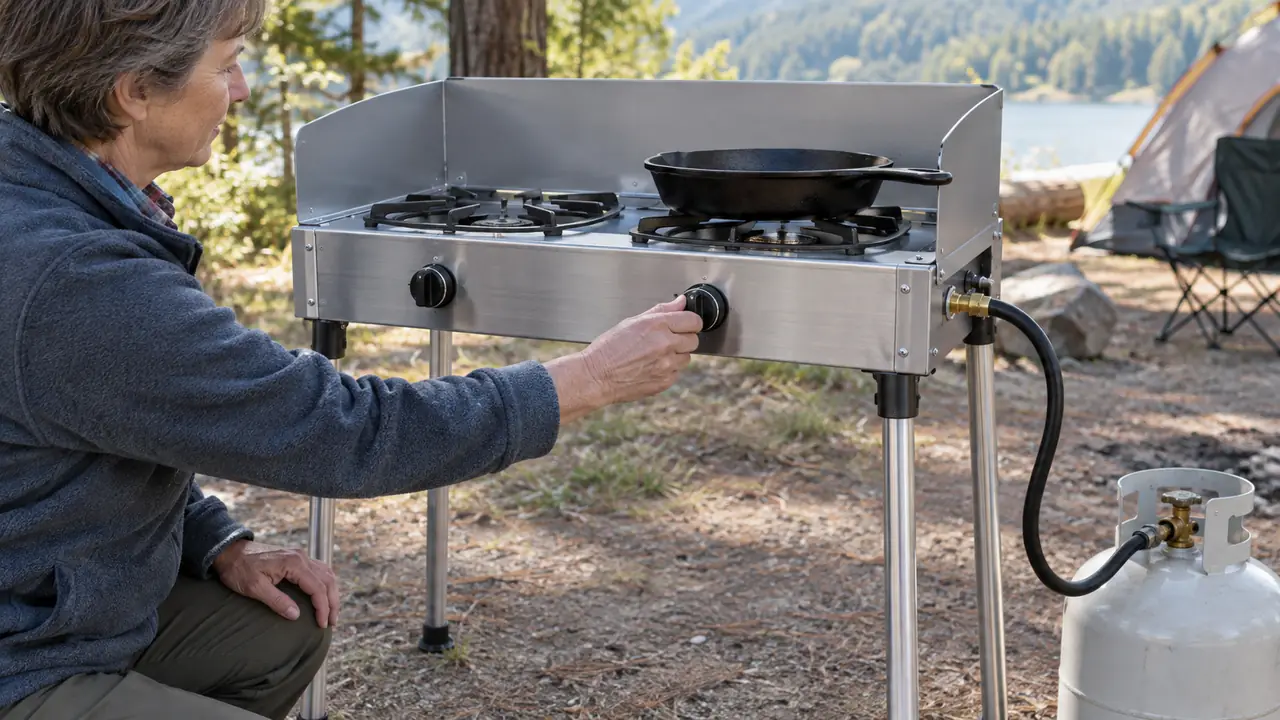
The Camp Chef Explorer puts out 60,000 total BTUs, which is roughly three times what the Coleman Triton produces. That is not a spec-sheet number, it is the difference between waiting fifteen minutes for a big pot of water and watching it come to a rolling boil in about half that. When I am cooking for six people, that heat is everything. The burners handle a full griddle without a cool spot in the middle, and I have seared a dozen burgers at once with no crowding.
The other thing the Camp Chef does better is stand up to wind. It has large fold-down windscreens that wrap around the burners, and on exposed sites above treeline I have had it hold a steady flame when the Coleman would have needed its guards and a rock wall. If you camp in open country or cook for groups, the Camp Chef Explorer is the more capable stove and it will still be working in ten years. The construction is heavy gauge steel, and nothing about it feels like it will wear out.
Where Coleman Triton Wins
The Coleman Triton weighs roughly 12 pounds and folds into a flat case that slips behind a seat or under a bin. For my knee, that is the difference between carrying the stove a hundred yards and asking Ray to do it. The Camp Chef Explorer is a base-camp piece of gear. It lives in the cargo area and comes out at the site. The Coleman is the one I can lift with one hand and set on a picnic table without thinking about it.
The Coleman also wins on price and simplicity. It costs a good deal less than the Camp Chef, and it uses the little one-pound propane bottles you can pick up at any gas station, or you can run it off a bigger tank with a hose. Setup is open the case, screw in the bottle, and light it. There is no regulator to attach and no hose to wrestle. For two people who want coffee and oatmeal at a trailhead, the Coleman Triton is the stove I reach for most weekends.
There is also the matter of where the stove goes when you are done. The Coleman Triton closes up into its own case and goes back under the bin. The Camp Chef Explorer needs to cool down, fold its legs, and then it sits loose in the cargo area, where it rattles around unless I wedge it. It is a small thing, but at the end of a long day of hiking, small things are what you notice.
If you cook for a crowd, the Camp Chef Explorer earns its space in the cargo area
The heat output and wind resistance make it the stove that actually cooks a group meal. It is heavy, and that is the tradeoff. If your trips are about feeding people, this is the one.
Amazon Check Today's Price on Amazon →What Each Stove Is Like in Daily Use
When I pull the Camp Chef Explorer out of the back of the 4Runner, it takes me about a minute to set up. The legs fold out and lock, the windscreens hinge up, and the regulator hose screws onto a standard 20-pound propane tank. It is not complicated, it is just heavier than it looks, and I have learned to set it up where I want it to stay because I am not moving it twice.
The Coleman Triton, by contrast, lives in a flat hard case that I keep under a bin. It takes maybe thirty seconds to have it open on a picnic table with a one-pound bottle screwed in. The burners are smaller and the heat is gentler, but for a pot of soup or a pan of eggs it is exactly right. The case also protects the stove in the back of the truck, which matters when you stack bins on top of things.
I have also learned that the Camp Chef Explorer needs a level spot more than the Coleman does. Its legs are fixed, so on uneven ground I end up propping a foot with a flat rock. The Coleman sits low and flat, so it is usually fine on a picnic table without fiddling. Neither is a dealbreaker, but it is the kind of thing that shows up over a season of use.
Fuel, Wind, and the Details That Matter
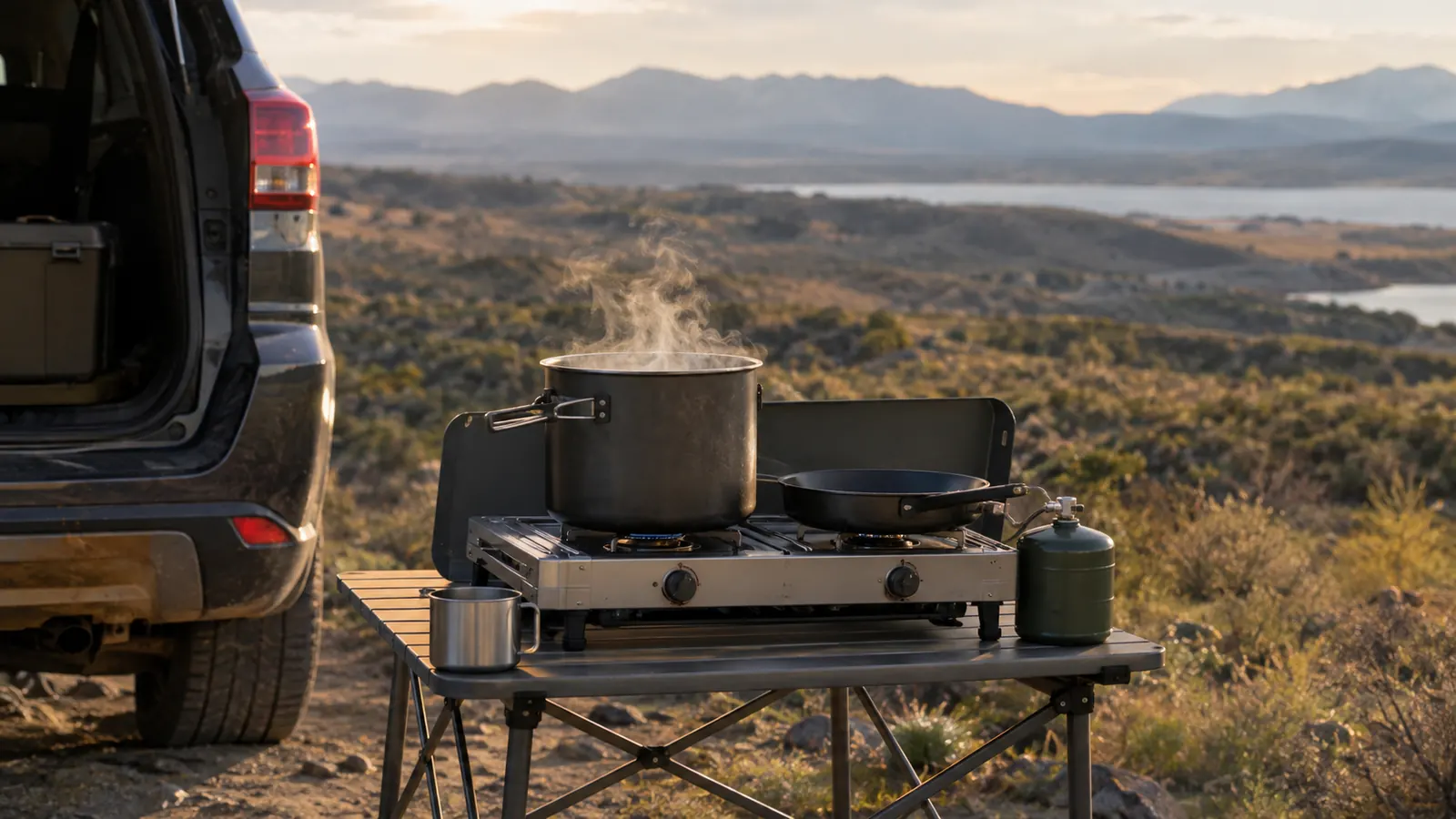
Both stoves run on propane, but the way you feed them is different. The Camp Chef Explorer is built for a 20-pound tank with a regulator hose, which is the setup most people want for group cooking because one tank lasts a whole weekend. You can buy an adapter to run it off the small bottles, but I have never bothered. The Coleman Triton runs straight off the one-pound bottles, which are easy but emptier than you expect when you are boiling water twice a day. On a long weekend I will go through two or three of them, so I carry a small box of spares.
Wind is the other detail. I have cooked on exposed ridgelines in northern Arizona where the breeze comes up hard at dusk, and the Camp Chef Explorer's big windscreens make the difference between a steady flame and a frustrating hour of babysitting the pot. The Coleman has decent built-in guards, and on a protected site under the pines it is fine, but when the wind picks up I have had to turn it to face away and shield it with a bin. For exposed camps, the Camp Chef wins without argument.
Durability and What Holds Up
I have dropped both stoves, driven over rough roads with them in the back, and left them out in light rain once or twice. The Camp Chef Explorer is built like a piece of equipment, heavy gauge steel, and it shows no sign of wear after four seasons. The regulator hose is the one part I watch, because that is the part that fails on any propane stove, and I carry a spare hose in the bin just in case.
The Coleman Triton has held up well too, and the hard case is the reason. It takes the abuse of being stacked under bins, and the stove itself still lights on the first click. The fold-down windscreens are thin metal, so I am careful with them, but after two seasons they are straight and true. Neither stove has ever failed me on a trip, which is the highest compliment I can give any gear.
Who Should Buy Which
Buy the Camp Chef Explorer if you cook for four or more people on most trips, if you use a griddle or big pots, or if you camp in places where wind is normal. Buy the Coleman Triton if it is usually just the two of you, if you want something light and flat that packs easily, or if you are on a budget and want a dependable stove that does not cost much. There is no wrong answer here. They are both good stoves, they just do different jobs.
Think about your last five trips. If most of them involved cooking for more than two, the Camp Chef Explorer will make those meals better. If most of them were just the two of you eating something simple at the picnic table, the Coleman Triton is the one you will actually use, and the one you will not resent carrying.
If you are still on the fence, think about the cooking you actually do, not the cooking you imagine. Most of our weekend trips are two people, and most of what I cook is eggs, soup, coffee, and the occasional steak in a cast iron pan. The Coleman handles all of it. But when we camp with friends and the group grows to seven people with a pot of chili to feed, I am very glad the Camp Chef Explorer is in the back of the truck.
The Bottom Line
After four seasons with the Camp Chef Explorer and two with the Coleman Triton, I keep both in the rotation. The Camp Chef comes out for group trips and big meals, and the Coleman comes out for quick weekends when I want to keep packing simple. If I had to own only one, it would depend on how I camped most often, and that is the honest answer. For most of my weekends, the Coleman is enough. For the meals I remember, the Camp Chef was the one doing the cooking.
The Camp Chef Explorer is the stove I trust for group meals
It is heavy and it takes up room, but it cooks like a real range and holds a flame in the wind. If you feed a crowd, this is the stove that makes the trip easier.
Amazon Check Today's Price on Amazon →