
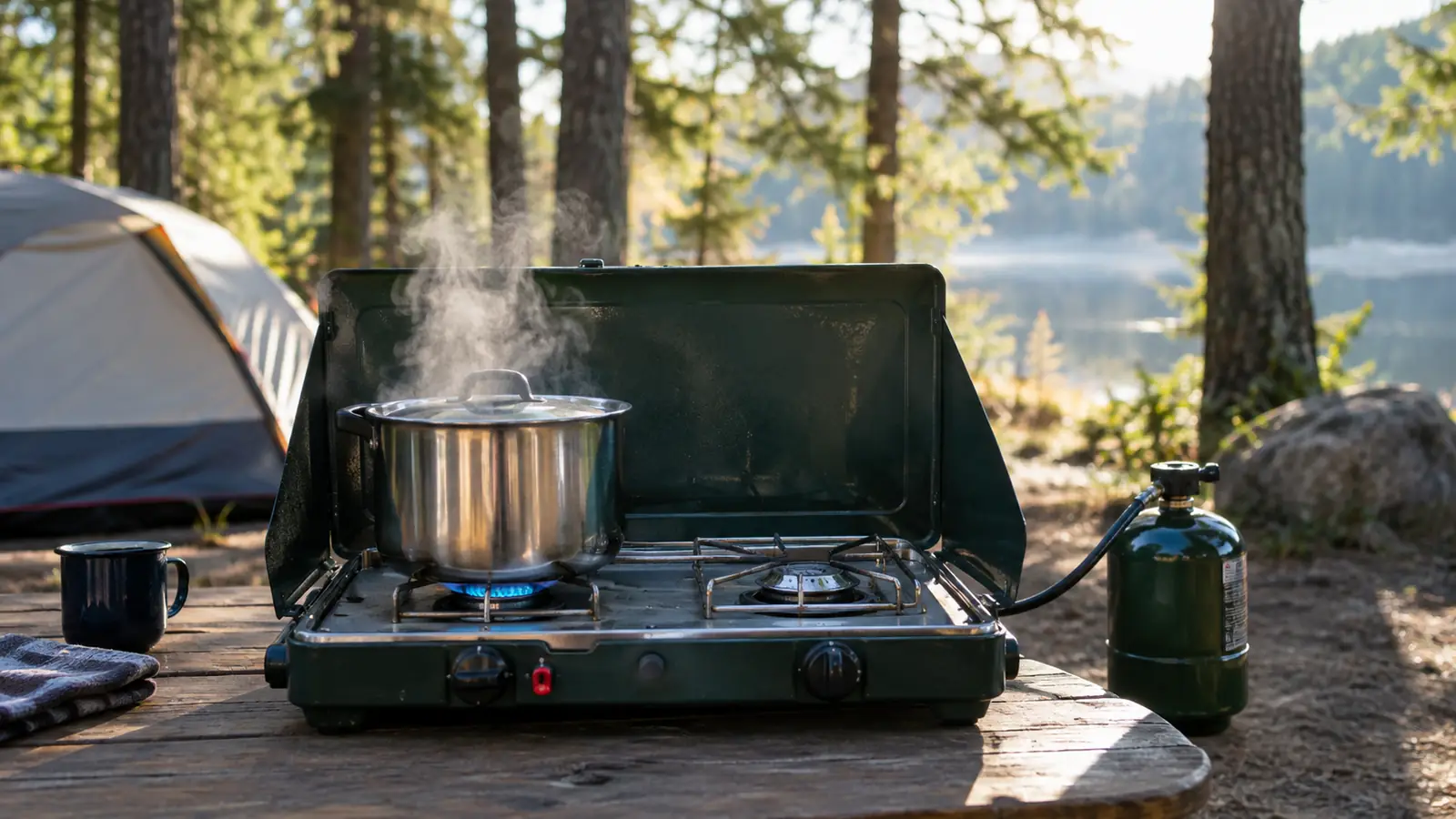
For the first three seasons I camped, I cooked on a single-burner stove that took forty minutes to boil water for coffee. I know the number because I stood and watched it every morning. My husband Ray and I camp about fifteen weekends a year, mostly northern Arizona, southern Utah, and the eastern Sierra, and every one of those mornings started with me waiting on a stove instead of drinking coffee.
So when we finally upgraded to the Camp Chef Explorer two-burner stove, I did not buy it for the BTU rating. I bought it because I was tired of cooking dinner in shifts and eating breakfast cold. Two seasons and about thirty nights of cooking later, it is the one piece of gear in the back of our 2016 4Runner that I would replace first if it disappeared. That is the highest compliment I can give anything we own.
The Quick Verdict
After two full seasons of weekend trips, the Camp Chef Explorer has become the backbone of our camp kitchen. It is heavy, it needs a sturdy table, and it takes a whole bin in the truck. But it boils coffee in under five minutes, cooks a real dinner for two on one burner while keeping a side warm on the other, and has not needed a single repair in thirty-plus nights of use. For car campers who cook real meals, it is hard to beat.
Amazon Check Today's Price →Two burners, real heat, and it still works like the day it arrived
After two seasons of camp meals, the Camp Chef Explorer is the stove I reach for on every trip. See today's price on Amazon and check whether it belongs in your camp kitchen.
Amazon Check Today's Price on Amazon →How I've Used It
We camp about fifteen weekends a year, plus one longer trip each fall. Everything rides in plastic storage bins in the back of the 4Runner, and the stove lives in its own bin with the fuel hose and a cast iron skillet. That bin is the first one out of the truck at every camp, because the stove is the first thing we set up.
The Explorer is a two-burner stove rated at 60,000 total BTUs, which in plain terms means it cooks like a home range instead of a camp stove. Coffee is done in under five minutes on a cold morning. Bacon and eggs cook at the same time, which sounds small until you have stood over a single burner for twenty minutes trying to do both. We cook dinner for two on one burner and run a pot of water for dishes or tea on the other.
By the end of the second season I had cooked somewhere around sixty meals on it. Chili, pasta, pancakes, foil packets of vegetables, and a whole chicken in a Dutch oven set on a grate over the flame. I have used it at 7,000 feet in April when the wind would not quit, and on a warm October weekend in Utah where we slept with the rain fly off. It does not care about the weather.
I keep a paper log of our trips in the front of my camp notebook, mostly so I remember which sites we liked. Flipping through it, the stove is in every single entry. That is the quiet proof of how much use it gets. It is not the gear that stays in the bin all season. It is the gear we would notice if it was missing.
The meal that sold me was not complicated. One October night at a site near the Grand Canyon's north rim, I browned ground beef for chili on the left burner while the right burner simmered the sauce and a pot of rice. Thirty minutes from lighting the stove to sitting down with a bowl. On the old single burner, that same dinner took an hour and the rice always suffered. Small things like that are why the stove stayed.
What 60,000 BTUs Actually Means at the Campground
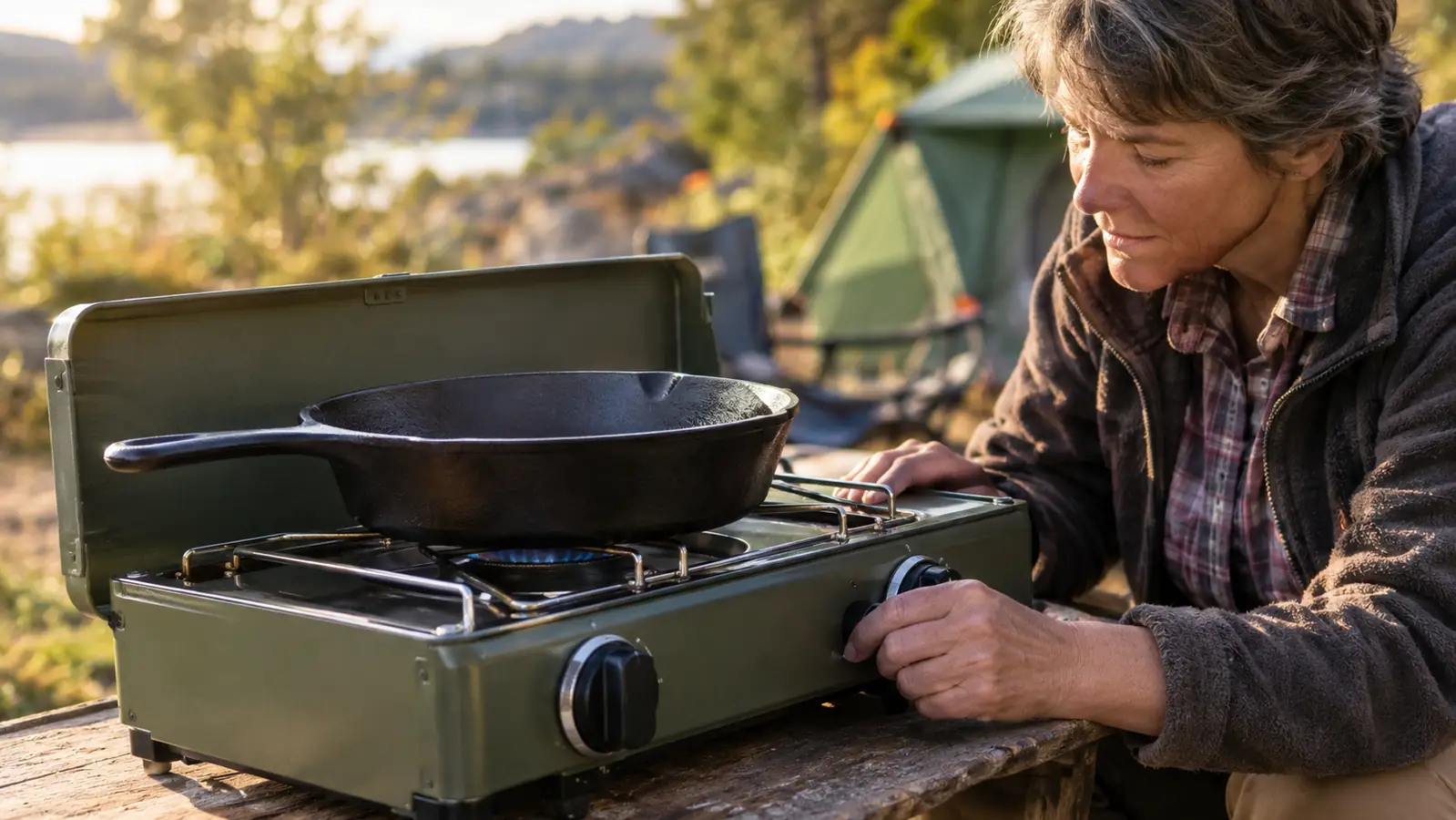
The number on the box is 60,000 total BTUs, which sounds like marketing until you cook on it. A typical two-burner camp stove runs around 20,000 to 30,000 BTUs combined. The Camp Chef Explorer puts out roughly double that, and the difference is not subtle. It is the difference between waiting for your dinner and cooking your dinner.
The burners are the real thing, not the thin rings you find on a budget stove. Each one throws even heat across a wide base, so a cast iron skillet sits flat and a Dutch oven gets heat exactly where you want it. The wind guards fold up around the sides and they actually do their job, which is rare. I stopped carrying a separate windscreen after the first season.
For someone my age with a knee that complains, the payoff is simple. I spend less time standing over the stove. Meals that took forty minutes on the old single burner take half that here. That is the whole reason to own this stove. It gives you the evening back, and at the end of a long hike, the evening is what you came for.
How It Has Held Up Over Two Seasons
Two seasons is about thirty nights of real cooking for us, plus a handful of day trips where we fired it up for lunch. The stove itself shows almost no wear. The burners have not clogged, the regulator has not given me a moment of trouble, and the metal body has picked up the normal scuffs of living in a plastic bin, but nothing has bent or broken.
The folding legs are where I expected trouble, because folding legs are usually the first thing to fail on camp gear. These have held up fine. The legs lock open with a solid click and the stove sits level on the camp table we use. On uneven sites I have set it directly on the ground a few times, and the legs took the angle without twisting.
The only maintenance I do is the same thing I would do for any stove. Let the burners cool, wipe down the cooking surface, and coil the fuel hose properly so it does not pinch in the bin. That is all. I have not taken anything apart and I have not replaced a single part. For gear that lives in the back of a truck and gets bounced down dirt roads, that is the durability I want.
Size, Weight, and What It Costs You in the Truck
Now the honest part. This stove is not light and it is not small. It weighs more than thirty pounds and takes a real footprint in the back of the 4Runner, which is why it lives in its own bin. If you are packing for a weekend, that is one bin you are not using for something else. For us the trade is easy. A real kitchen in exchange for one bin.
Setup takes about two minutes. You unfold the legs, connect the hose to a standard 20-pound propane tank, open the valves, and light it. There is no assembly, no tools, and no parts to lose. The first time I set it up in the driveway, it took longer to read the box than to get it burning.
Carrying it is the only part my knee notices. From the truck to the table is about ten feet for us, and that is fine. If you walk a quarter mile from a parking area to your site, this is not your stove, and that is a real limitation, not a nitpick. I will say it plainly in the section on who should skip it.
One thing that surprised me is how steady the flame stays even when the tank gets low. We ran a tank nearly empty on the last night of a fall trip and the stove still cooked dinner without the sputtering I expected. I do not know the engineering behind it, but I noticed it, and it saved a meal.
What It Does Not Do Well
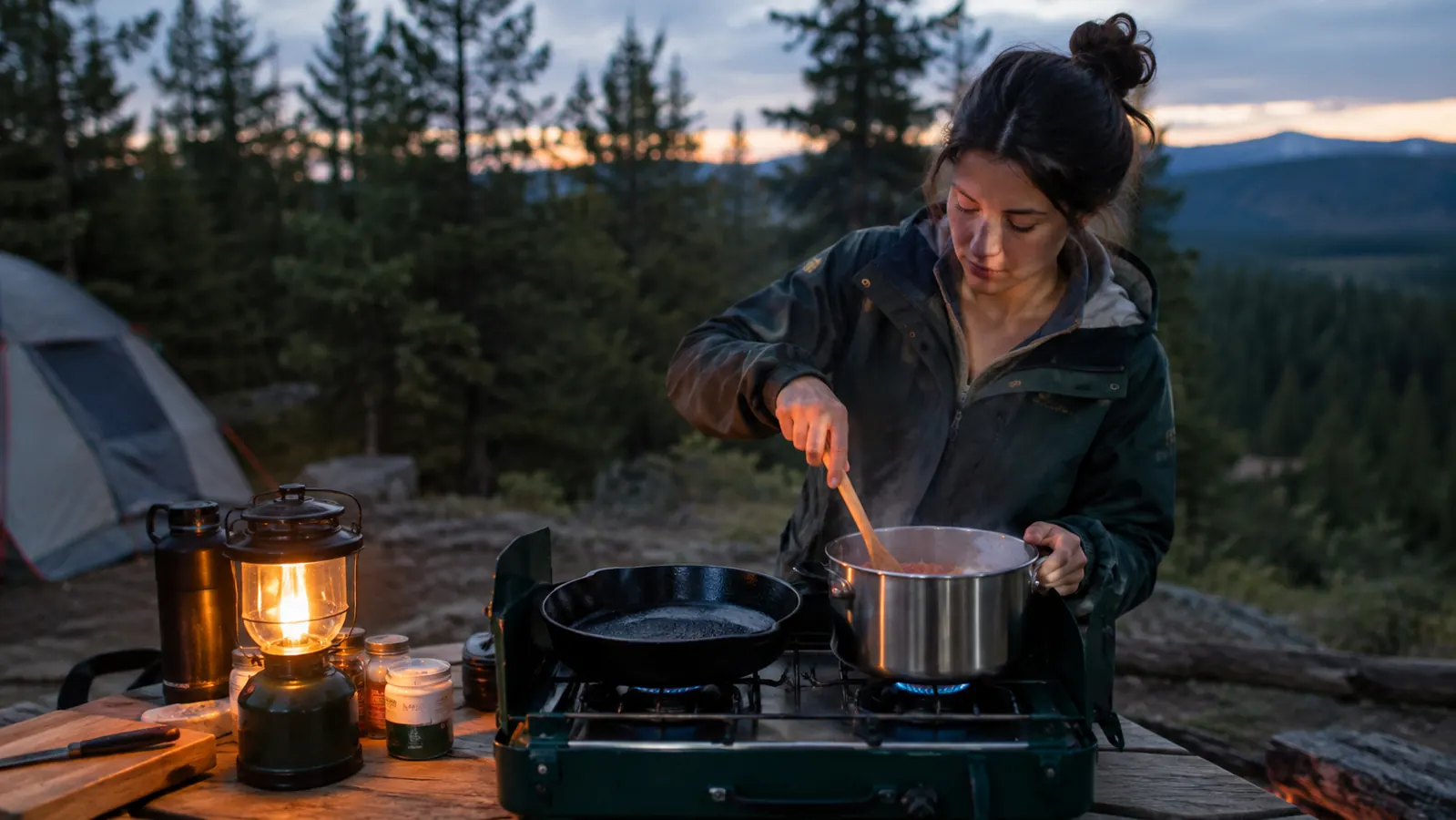
Nothing is perfect, and the Explorer has a few habits worth knowing before you buy. The biggest is wind. Even with the fold-up wind guards, a strong gust can push the flame around the outer edge of a big skillet. On exposed ridgelines we angle the stove away from the breeze and it is fine. On a truly windy day, you will be glad you parked the truck between you and the wind.
Second, it is a propane stove, so you are tied to a tank. We carry one 20-pound tank and a small backup for longer trips. If you prefer the convenience of the little green canisters, this is not the stove for you, because it needs the bigger hookup. That is a planning detail more than a problem, but it is worth knowing before you buy.
Third, the griddle top is sold separately, and you will want it if you cook breakfast for more than two people. We use a cast iron skillet instead, so we never bought the griddle, but it is an extra expense to factor in if pancakes and eggs are your camp breakfast. None of these are reasons to avoid the stove. They are reasons to buy it with your eyes open.
The Alternatives I Considered
Before we bought the Explorer, I looked hard at the Coleman Triton, which is the stove most people land on when they search for a two-burner. It is lighter, cheaper, and easier to store, and if you mostly cook simple meals for a couple of nights, it is probably the smarter buy. I have used one on a friend's trip and it cooks fine. It just does not have the same raw heat, and it does not have the same wind resistance.
The other direction is a full camp kitchen setup, which for us was overkill. We do not need a fold-out table with a built-in sink and a dedicated prep counter. We need two burners that get hot and a flat place to set them. The Explorer sits right in the middle of that range, and it has been the right middle for us. There is a full head-to-head comparison with the Triton if you want the detailed breakdown.
And if you are still deciding between a single and a two-burner stove at all, I will save you some time. For anyone who car camps out of a vehicle and cooks real meals, the two-burner wins on almost every trip. The single burner stays home with us now, and I do not miss it. There is also a list of ten reasons the two-burner beats the single burner for exactly this kind of camping.
What I Liked
- Real cooking power. Two burners, 60,000 total BTUs, and water boils in minutes instead of forever
- Built like permanent equipment. Two seasons of hauling and it still works like new
- Stable folding legs and wind guards that actually do something
- Simple hookup to a standard 20-pound propane tank, no special fittings
- Easy to clean and a breeze to maintain
Where It Falls Short
- Heavy and bulky. It needs its own bin and a sturdy table
- Tied to a 20-pound tank, so no option for the small canisters
- Wind can still push the flame around on exposed sites
- The griddle top costs extra if you want one
After two seasons and thirty nights of cooking, nothing has bent, broken, or needed replacing.
Who This Is For
This is the stove for people who car camp the way we do. Out of bins in the back of a vehicle, cooking real meals, and done with the hassle of a single burner. If you cook breakfast and dinner at camp most weekends, if you own a cast iron skillet and actually use it, if you would rather spend twenty minutes at the stove than forty, this is your stove.
It is also for anyone who is tired of replacing camp gear every couple of years. We have had this one for two full seasons and it shows no sign of slowing down. The build quality is why it carries nearly 9,500 reviews and a 4.7 rating. People keep this stove for a long time, and at 54, I have learned to buy the thing I will not have to buy again. My father taught me that lesson with a cast iron skillet he used for forty years, and I think of it every time I set this stove up.
Who Should Skip It
Skip it if you hike in to your campsite. At more than thirty pounds, this is a vehicle stove, full stop. If you carry your kitchen on your back, you want something that weighs a fraction of this and packs flat. The Explorer would be a mistake for you, and I am not going to pretend otherwise.
Skip it also if you camp a couple of times a year and mostly heat up canned chili. A lighter, cheaper two-burner will do that job and take up less space in the truck. And if you pack tight for every trip, the bin this stove needs is a real cost. Buy the stove that matches the cooking you actually do, not the cooking you imagine you will do.
The stove that earned its spot in the truck
After two seasons of real meals at camp, the Camp Chef Explorer is the one piece of gear I would replace first. Check today's price on Amazon and see if it fits your camp kitchen.
Amazon Check Today's Price on Amazon →