
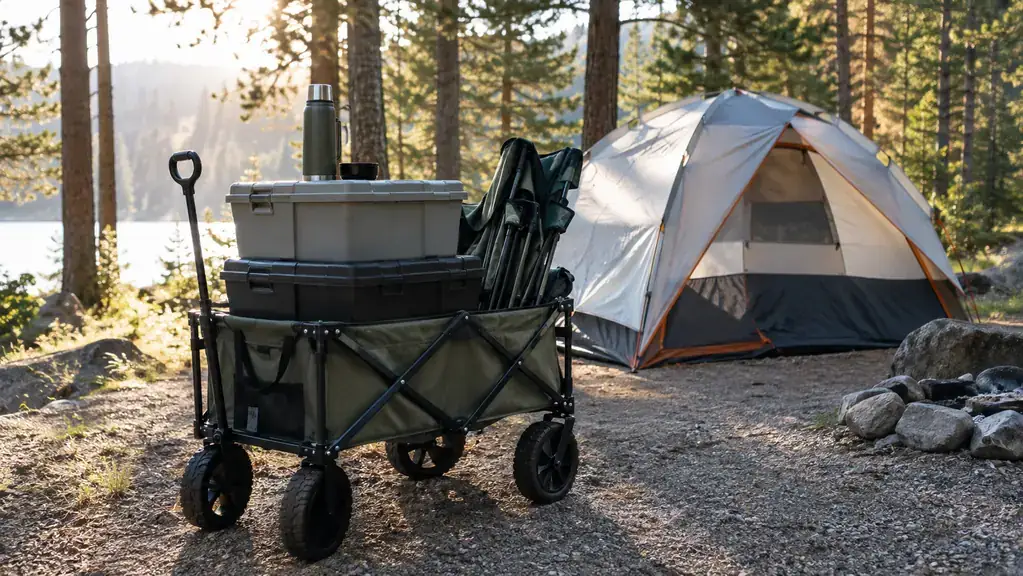
The last time we car camped before I bought the wagon, I counted the trips from the 4Runner to the tent pad. Four. Four trips, each one with a plastic bin in my arms and my right knee complaining by the second pass. The cooler alone was forty pounds, and the walk was maybe two hundred yards of gravel and pine needles. By the time the tent was up, I was done for the afternoon, and the hike I had planned for the morning felt like a chore instead of the point of the trip. That was the trip that changed how we pack.
That was the season I bought the ROSONG Collapsible Wagon Cart. Not because I wanted another piece of gear to store in the garage. Because I wanted the whole camp to move in one trip, and I wanted my knee to still work the next morning. The wagon is a simple tool, and the method for using it is simple too. It comes down to five steps I have refined over about a season and a half of weekends in northern Arizona and southern Utah.
Before the wagon, our system was arms full of bins and a folding chair strapped to my backpack. It worked, barely. Things got dropped, the chair came loose on the trail, and every trip meant two people walking back and forth with no rhythm. The wagon did not just replace the carrying. It replaced the arguing about who carried what.
Four Trips Became One
The ROSONG folding wagon carries what used to take me four trips from the truck to the tent. If you are tired of the parking-lot shuffle, this is the tool that ends it.
Amazon Check Today's Price on Amazon →The Five-Step Routine That Ends the Parking-Lot Shuffle
The method is the same whether we are at a Forest Service campground outside Flagstaff or a dispersed site in southern Utah. The parking lot changes, the distance changes, but the routine does not. Five steps, and the first one happens before the wagon ever touches the ground.
Step 1: Pack the Wagon at the Tailgate, Not at the Site
The tailgate of the 4Runner is the best loading table you will ever have. Lower it, slide the wagon up to it, and load everything at waist height instead of bending down to the ground. That matters more to me than it used to. My right knee has been unhappy since a fall on the Kachina Trail a few years back, and every bend to the ground is a small tax. Loading at tailgate height means I do almost none of that, which means I still have a knee left for the hike the next morning.
Put the heavy things low and centered over the wheels. For us that is the cooler, the five-gallon water jug, and the bin with the cast iron skillet. The lighter bins go on top, and the tent poles and camp chairs go on top of everything. If the wagon wants to tip backward when you lift the handle, you have loaded it wrong. Take the weight off the handle and redo it before you start walking. The fix takes a minute. The tip-over takes a whole afternoon.
Think about the order you will need things at the site. Tent first, so it goes on top or near the top. Kitchen bin last, because it is the last thing you will use. This sounds obvious. The first time I loaded the wagon, I buried the tent under the cooler and stood at the tent pad with nothing to do but dig through bins while Ray held the tent bag and waited. Now the tent goes in last, on top, and I can have it out of the wagon and in Ray's hands before the wagon stops rolling.
Step 2: Unfold and Lock the Frame Before It Takes Any Weight
The ROSONG folds flat enough to stand against the back seat of the 4Runner, which is why it lives in the truck all season instead of in the garage. But it has to be fully opened and locked before it takes any weight. The frame locks into place with a positive click. If you skip that and just start loading, the wagon will fold itself around the load the first time you hit a root, and you will be standing on a trail holding a collapsed wagon and a pile of bins.
Give the wheels a quick check while the wagon is empty. Make sure nothing is wrapped around the axles and no pebble is wedged in a wheel. A stuck wheel sounds like a small problem until you are pulling eighty pounds of camp gear over a gravel path and the wagon is trying to steer itself into the trees. Thirty seconds of checking saves a whole walk of fighting.
Do this at the tailgate, not at the site. I have watched people wrestle a half-open wagon across a parking lot, and it never ends well. The lock is there for a reason. Use it. And when you fold the wagon back up at the end of the trip, make sure it clicks back into its folded shape before you stand it against the seat, or it will unfold itself across the back of the truck on the drive home.
Step 3: Load for the Terrain, Not for the Parking Lot
The walk from the parking lot to the tent pad is never flat. It is gravel, then a root, then a slope, then a patch of sand. Load the wagon for that, not for the smooth asphalt where you packed it. Keep the center of gravity low and the load as narrow as the wagon. A top-heavy load will tip on the first slope, and you will repack everything on the trail with an audience of chipmunks.
Tie down what can shift. A bungee across the top of the bins costs two seconds and saves the whole trip. The cooler stays put if it is wedged between two bins, but the camp chairs will slide no matter what. What you do not want is a load that shifts when you hit a root, because a shifting load tips the wagon, and tipping the wagon means repacking on a slope. The bungee is cheaper than the argument.
Know when to stop adding. I load the wagon until the frame starts to complain, and then I take one thing out. It is better to make a second trip for the firewood than to flip the wagon and repack everything on the trail. The wagon has a limit, and the limit is usually lower than the amount of stuff you think you need. If you are not sure, err on the side of the second trip.
Step 4: Pull It the Way That Protects Your Back and Knees
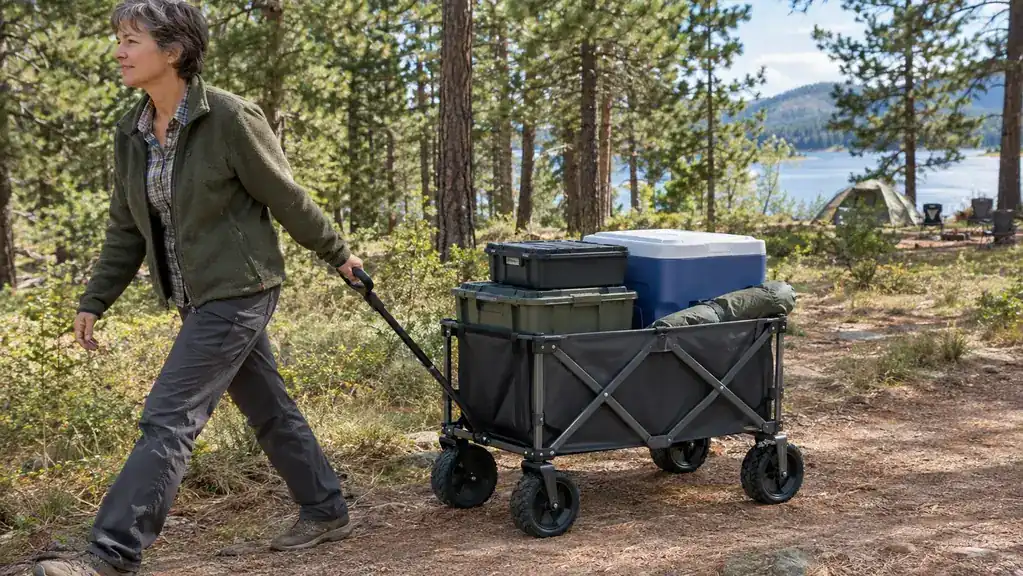
The handle is the difference between a wagon that saves your back and one that wrecks it. Keep the handle at hip height so your arms are nearly straight. If you are pulling with bent elbows and your hands at chest height, you are using your shoulders instead of your legs, and your back will let you know about it by the second trip. Straight arms, steady pace, let the wheels do the work. If you find yourself hunching over the handle, stop and shorten the distance between you and the wagon rather than bending at the waist.
On any slope, pull from the downhill side. That way, if the wagon tips, it tips away from you instead of onto your legs. This is the one technique I have to remind myself about every single time, because the natural instinct is to walk uphill of the wagon and pull it across the slope. Walk downhill of it instead. Your knees and your shins will thank you, and so will anyone walking behind you.
Pace matters more than people think. A steady walk beats a fast one, because a fast walk bounces the load, and a bouncing load shifts, and a shifted load stops you for a repack. Ten extra minutes of steady pulling beats ten minutes of fixing a tipped wagon on a gravel path. If the site is two hundred yards from the truck, the whole pull should take about five relaxed minutes, and that is the whole point.
Step 5: Unload in Order, Then Fold It Before Dinner
Unload in the reverse order of your packing list. Tent first, because it is the first thing you need. Then the sleeping bins. Leave the cooler in the wagon until the tent is up, because the cooler is the heaviest thing you carried and there is no reason to move it twice. By the time the tent is standing, the wagon is already half empty, and the kitchen bin is the only thing left in it.
The wagon earns its keep after the tent is up. Use it to haul water from the spigot, to bring firewood from the pile, to move the camp chairs to the spot where the sunset shows. The water spigot at the Forest Service campground is usually a quarter-mile from the sites, and hauling five gallons by hand is exactly the kind of trip that used to end my day early. Ours gets more use in the first hour at camp than it does on the whole walk in. It becomes the camp cart, and everything at camp is suddenly easier to move, including the things you did not plan to move.
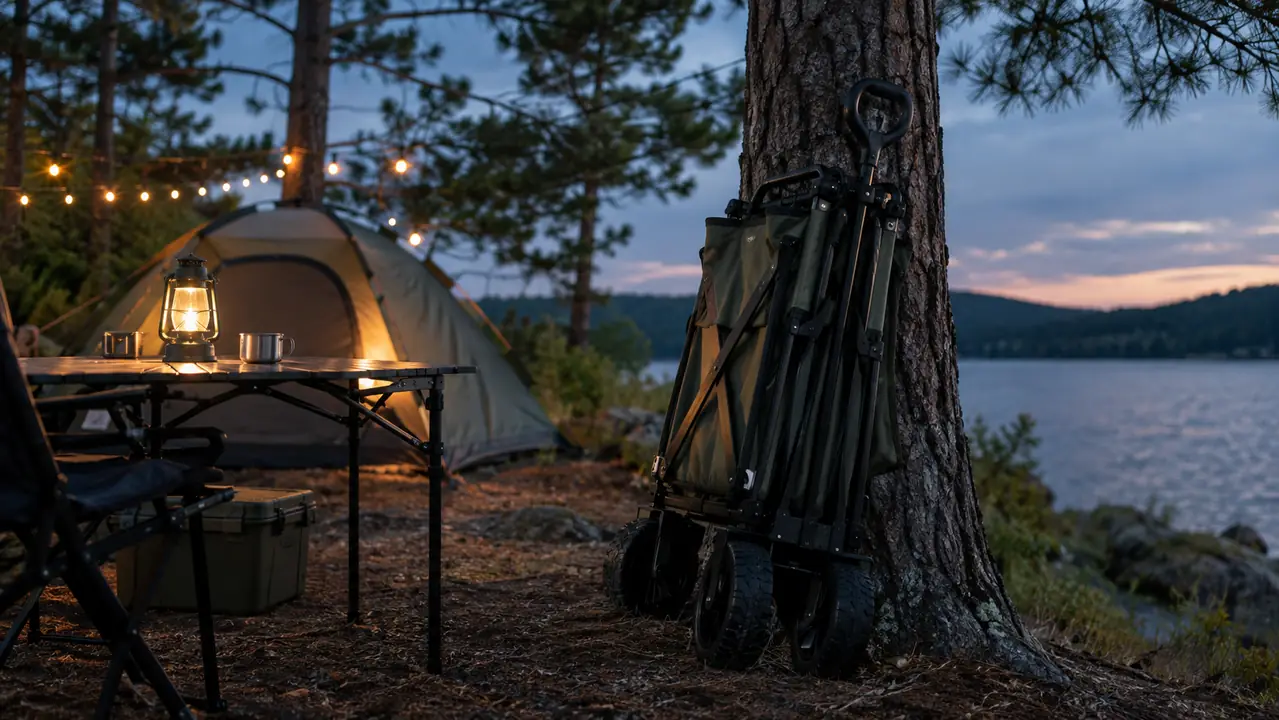
Then fold it. A folded wagon leaning against a tree stays dry and out of the way. Leave it open and it collects dew, and somebody will trip over it in the dark on the way to the fire. Folding takes about a minute, and it means the wagon is ready to roll back to the truck in the morning, loaded with everything that needs to go home. Unfold, load, roll. The reverse of the morning, minus the knee complaints.
What Else Helps
The wagon works because of what it carries. The plastic bins in the back of the 4Runner are the real system. Each bin is one category: kitchen, sleeping, tools, and a small one for the first-aid kit and headlamps. The wagon just moves the whole system at once. If you are starting from scratch, buy the bins first and the wagon second. The wagon without the bin system is just a cart with a pile of loose stuff in it.
Beyond the bins, the list is short. Two or three bungee cords, a tarp to keep the wagon clean in the truck, and a headlamp for the evening water run. That is the whole kit. None of it is fancy, and none of it adds weight you will regret on the pull back to the truck on Sunday.
One honest note: the wagon is a car-camping tool, and it knows its job. If your site is a quarter-mile hike up a rocky trail, leave the wagon at home and pack lighter. For every site where the parking lot is close, though, it turns the worst part of car camping into the easiest part.
If you want the durability picture over a full season, the long-term ROSONG wagon review covers exactly that. And if you are deciding between this wagon and the Blomoba, the head-to-head comparison spells out the differences. Both are worth a read before you buy.
Four trips became one trip, and my knee made it to the trailhead the next morning.
Make This Season the One-Trip Season
The ROSONG folding wagon turns the parking-lot shuffle into a single walk from the truck to the tent. Check today's price on Amazon and see if it fits your camp setup.
Amazon Check Today's Price on Amazon →