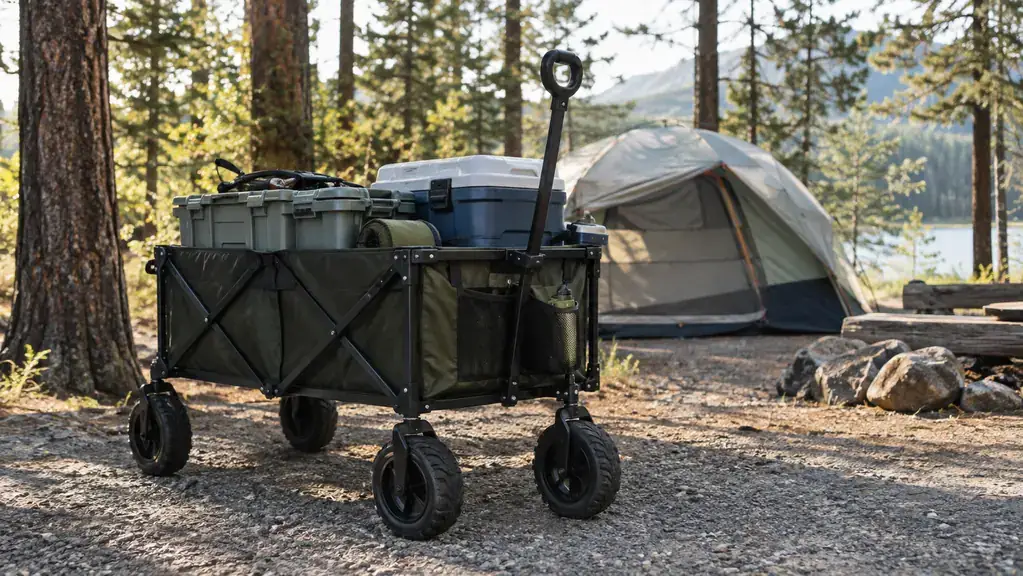
The moment I knew the ROSONG wagon had earned its permanent spot in the back of the 4Runner came on a Saturday in late June, at a site near the Mogollon Rim. The trail from the truck to the tent pad was a quarter mile of packed gravel and tree roots, and the old way of doing it meant three trips: one for the two 18-gallon bins, one for the cooler and the chairs, one for the firewood and the odds and ends that never fit anywhere. By the third trip my right knee, the one that has not been the same since I came down wrong on the Kachina Trail two years ago, was talking to me. That Saturday I loaded both bins into the ROSONG wagon, wedged the cooler in on top, hung the chairs off the sides, and walked the whole camp in one pass.
This is the long version of that story. The wagon has now done every trip we took this season, which is fifteen weekends scattered across northern Arizona, southern Utah, and the eastern Sierra, plus a nine-day stretch in October. It has hauled firewood, wet tents, a full cooler, a borrowed camp stove, and the bag for our six-person dome tent, which Ray carries because it is the one thing that does not fit. This is what a full season of hauling gear taught me about the ROSONG Collapsible Wagon Cart.
The Quick Verdict
The ROSONG wagon turned every car-to-campsite carry from a three-trip knee complaint into a one-trip walk. It is not for soft sand or steep rock, and the fold takes a minute to learn, but for camping out of bins it is the best gear purchase I made all season.
Amazon Check Today's Price →One trip instead of three, all season long
If you camp out of plastic bins like we do, the ROSONG wagon is the difference between three walks down a gravel trail and one. It folds flat enough to live in the back of the truck between trips, and after a full season ours still folds, rolls, and locks like it did in May.
Amazon Check Today's Price on Amazon →How I've Used It
The wagon lives folded in the back of the 4Runner, wedged between the two bins that hold the tent and the kitchen gear. It goes on every trip whether we plan to need it or not, because the trips where we did not think we would need it were exactly the ones where it saved the day. The most useful it ever was had nothing to do with camp. We stopped at a trailhead in southern Utah where the parking lot sat a quarter mile from the trail, and the friend we were with was on crutches from a sprained ankle. The wagon carried the day packs, the water bottles, and the crutches, and the friend walked in with one hand on the wagon frame. That was the afternoon Ray stopped calling it my wagon and started calling it the wagon.
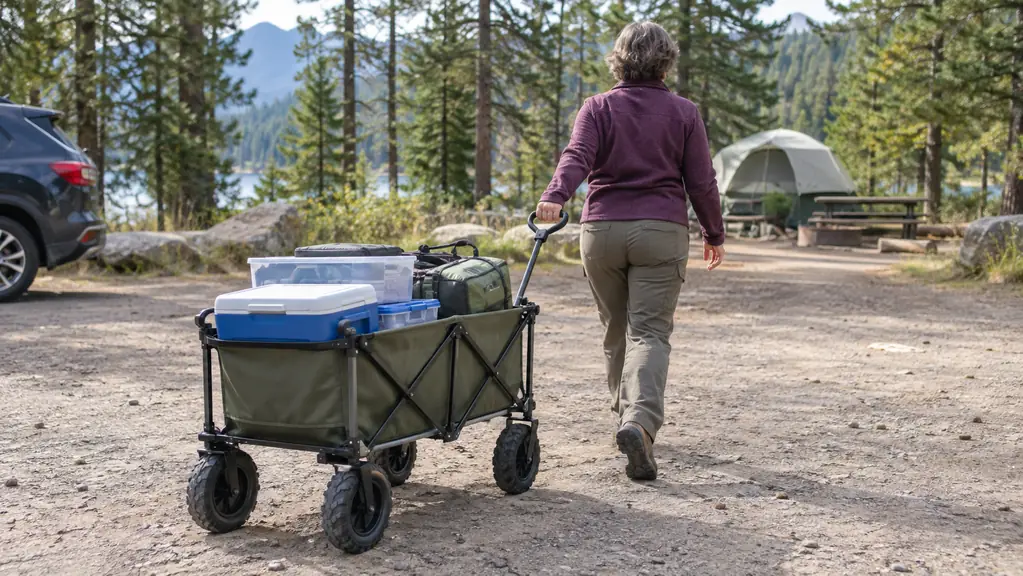
In a normal weekend the load is the same every time: two 18-gallon bins, one on top of the other, the 52-quart cooler wedged in beside them, and the two camp chairs leaning against the sides. That is the whole camp minus the tent, and it fits with room to spare. On the firewood run the bins stay behind and the wagon carries a bundle of wood plus the ax, and it does that job well enough that we stopped carrying firewood by hand at all.
The handle is the detail I would not have thought to care about. It sits at a height where I do not hunch and Ray does not kick it with his heels, and that matters more than it sounds. When the wagon is loaded and rolling, the handle is the whole conversation between you and the load. A handle that fights you ruins the trip. This one does not fight.
The Fold, the Unfold, and the First Scratched Knuckle
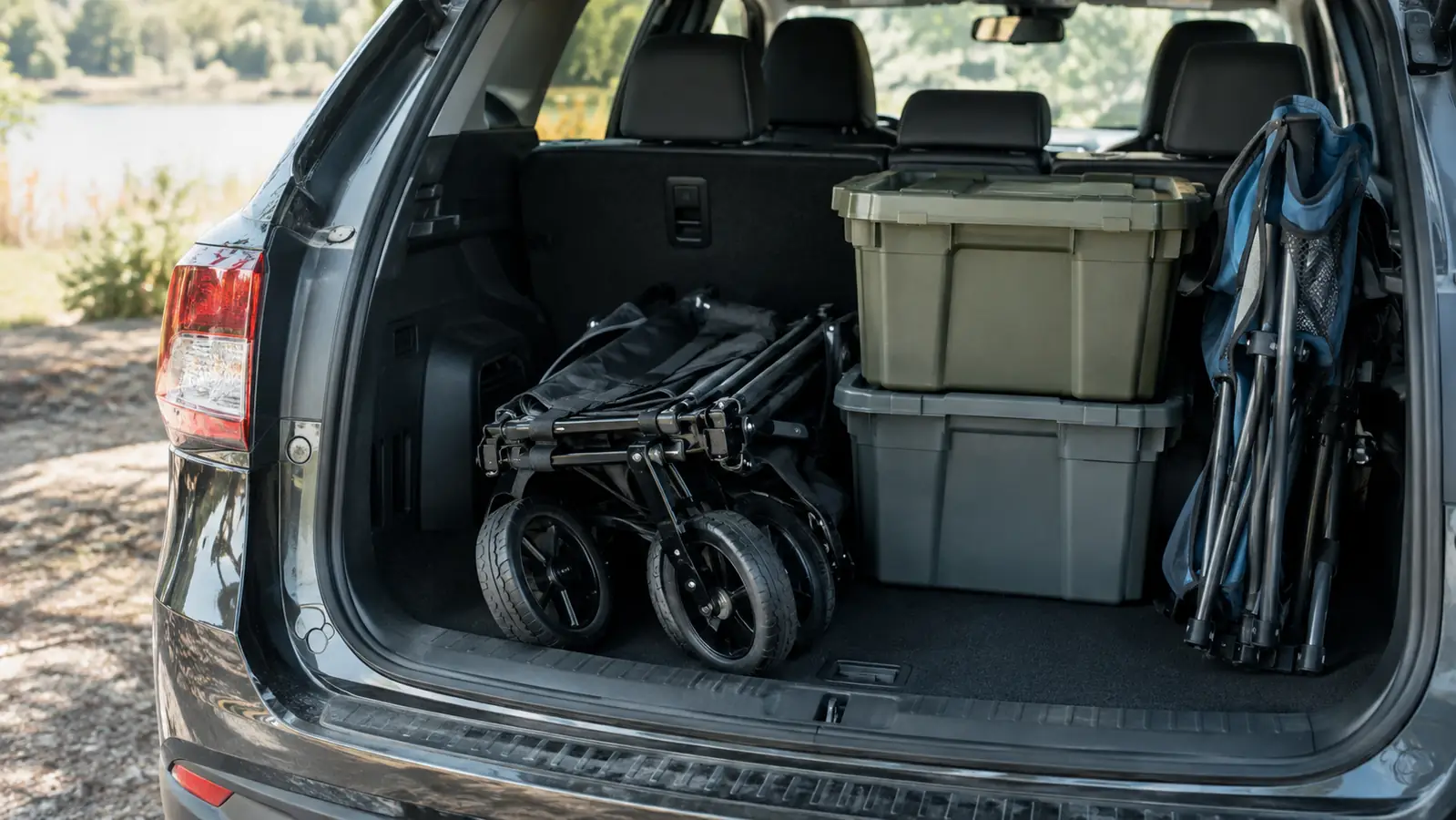
The fold is the part that makes or breaks a wagon like this, because a wagon that does not fold flat is a wagon that lives on the porch and never goes anywhere. The ROSONG folds down to roughly the size of a large suitcase, which is the only reason it can live in the back of the 4Runner full time. The first time I folded it, it fought back. There is a set of locking tabs on the frame, and the trick is to release them in the right order and then pull up on the floor of the bin while the frame collapses. The first time took me close to five minutes and a fair amount of harsh language. By the third trip it was under a minute. By the end of the season I could do it without looking.
The unfold is easier than the fold. You pull the frame apart, the floor of the bin pops into place, and you are done. The one thing I will warn anyone about: keep your fingers clear of the hinge points when it snaps open. I pinched a knuckle on the second trip of the season, and it was the kind of pinch that makes you say things you would not say in front of company. It healed fine. I learned to pay attention.
Storing it flat is genuinely useful. It fits between the wheel wells in the back of the 4Runner with room to spare, which means it does not cost us cargo space we do not have. On the long October trip to the eastern Sierra it rode under the sleeping bags and never got in the way. A wagon that folds flat enough to forget about is the only kind of wagon that will still be in the truck next spring.
What Fits, What Does Not, and the Geometry of a Full Cooler
The honest answer is that the wagon bin is bigger than it looks and smaller than you will hope, and the difference matters. Two 18-gallon storage bins fit side by side with a little room to spare. A 52-quart cooler fits if you accept that it will sit at a slight angle. What also does not fit, and this took me a whole season to accept, is everything. You will still make a second trip sometimes. The wagon does not make the second trip disappear. It makes the second trip optional.
The chairs are the thing I figured out late. They do not fit inside the bin with the other gear, but they hang off the sides of the frame without shifting, and that turned out to be the difference between one trip and two. Once I learned to treat the sides of the wagon as part of the cargo space, the load math changed. A full camp minus the tent in one pass. That is the number that matters: one.
The one load that beat it was firewood. A bundle of split wood is heavy and awkward, and it rolls around in the bin no matter how you stack it. The wagon handled it, but the wood shifted on every bump and I had to re-stack it twice on a hundred-yard walk. If the bulk of your hauling is firewood, bring bungee cords from day one.
Wheels, Gravel, and the Places a Wagon Should Not Go
On packed dirt, gravel, and the kind of graded forest road that passes for a trail at most car campsites, the ROSONG wagon rolls easily. The wheels are wide enough that they do not sink into soft dirt, and the wagon tracks straight when you load it evenly. The day I loaded it unevenly, with the cooler on one side and nothing on the other, it pulled hard to the left the whole way and I spent the walk fighting the handle. Load it even. The wagon will not do the work for you.
The places it will not go are the places you should not ask it to go. Soft sand is the big one. We camped one weekend near the dunes in southern Utah, and the wagon sank to its axles in the loose stuff. I ended up half carrying it, which is exactly the thing a wagon is supposed to prevent. Steep rocky trail is the other one. The wheels roll over rocks up to a point, and past that point the whole wagon tips and you spend the rest of the walk with one hand on the load. Neither of those failures is a design flaw. They are the edges of what a wagon with four wheels can do.
The knee test is the one that matters to me. The reason I bought a wagon at all is that my right knee, after the fall on the Kachina Trail, does not like being the thing that carries weight over distance. Carrying a 40-pound bin a quarter mile is exactly the kind of load that makes it ache for two days. Pulling the same bin in the wagon uses my arms and my good leg, and the knee just walks. By the end of the season I stopped planning the walk from the truck to the site around which trips I could skip.
What a Season Did to It
After fifteen weekends and a nine-day trip, the wagon looks like a piece of gear that has been used, which is the correct look for a piece of gear that cost what this one costs. The frame is still square. The fold still locks and unlocks cleanly. The wheels still spin freely, and the two wheels that I expected to wobble by August have not developed any wobble. The fabric bin has a few scuffs on the outside from rubbing against the wheel wells in the back of the truck, but no tears and no loose seams. I will take that trade.
The only real wear is on the handle grip, which has worn smooth on the side where my hand rests, and on the bottom corners of the bin where it scrapes the ground when the wagon is stored upright. Neither affects how it works. The latch that holds the wagon closed when it is folded still clicks shut, and that is the latch I was most worried about, because a wagon that will not stay folded is a wagon that lives on the porch.
The thing I did not expect is that the wagon got more useful as the season went on, because I got better at loading it. The first few trips I treated it like a car trunk and piled things in. By October I was stacking the bins first, wedging the cooler in at the angle that fits, and hanging the chairs off the sides before I even lifted the handle. The wagon did not change. I did. That is the honest review of any piece of gear that earns its place.
What I Liked
- Folds flat enough to live full time in the back of the 4Runner
- One trip replaces three for a two-person camp
- Handle height works for both of us without hunching
- Wheels handle gravel, packed dirt, and tree roots without complaint
- Frame and fold still tight after a full season of use
Where It Falls Short
- Soft sand stops it dead, and you will be half carrying it
- The fold has a learning curve, and the first try may cost you a knuckle
- Uneven loads pull hard to one side
- Firewood rolls around in the bin without bungee cords
By the end of the season I stopped planning the walk from the truck to the site around which trips I could skip. That is the whole review in one sentence.
Who This Is For
Buy the ROSONG wagon if you camp the way we camp: out of plastic bins in the back of an SUV, at sites where the walk from the vehicle to the tent is measured in hundreds of yards, not tens. Buy it if your knees or your back have started to negotiate with you about what you carry. Buy it if you are tired of the three-trip shuffle, where you get the tent in and then have to go back for the cooler and then go back again for the chairs. Buy it if you want one piece of gear that makes the whole setup faster, because the wagon is the thing that lets you carry the whole camp in one pass.
It is also for the trips that are not camping. It has hauled groceries from the car to the door of a rental cabin, hauled a week's worth of firewood to a picnic table, and hauled a load of wet gear from the car to the laundry room after a rainy weekend in October. The wagon does not know it is supposed to be a camp wagon. It just rolls.
Who Should Skip It
Do not buy the ROSONG wagon if your camping is backpacking, because you will not carry it and it will live in your garage. Do not buy it if you camp in deep sand or on steep rocky trails, because it will sink, tip, and make you wish you had just carried the bins. Do not buy it if your vehicle is small, because folded it is still the size of a large suitcase and it will eat cargo space you may not have. And do not buy it if you expect it to carry everything, because it will not. The tent bag does not fit. The load needs to be balanced. The firewood needs bungee cords. It is a tool, not a promise.
The person this wagon is wrong for is the person who wants one piece of gear to solve every carrying problem. It solves the specific problem of hauling a two-person camp from the car to the site, and it solves it well. Everything else it does is a bonus.
The wagon that made camp setup a one-trip job
After a full season, the ROSONG wagon still folds flat, rolls straight, and earns its space in the back of the truck. If you haul camp gear out of bins like we do, this is the piece of gear that quietly changes every trip.
Amazon Check Today's Price on Amazon →