
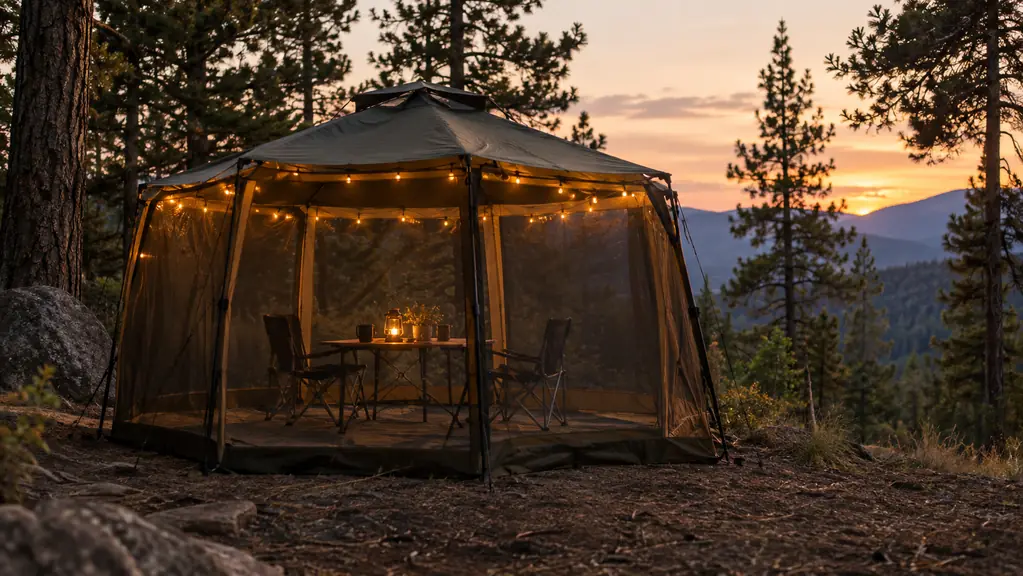
By the third weekend of last spring I had made my peace with eating dinner inside the tent. The mosquitoes at the trailhead were thick enough to drink my coffee for me, and the wind off the mesa kept putting out the stove. Ray suggested we just eat in the vestibule. I told him I would rather eat standing in the parking lot. That kind of stubborn is what finally made me buy a screen house.
This is the long version of that decision. I have had the Alvantor pop up screen house for a full season now, twelve nights out across northern Arizona and southern Utah, and it has quietly become the first thing we set up at a new site. It is not the fanciest piece of camp gear we own. It is the one that gets used the most.
The Quick Verdict
The Alvantor screen house turned every buggy evening into a usable one. Setup is genuinely under two minutes once you know the case, it holds up to a normal monsoon breeze, and after a full season it shows almost no wear. It is bulky to carry and it is not a shelter for a serious storm, but for car camping it is the best fix for dusk I have found.
Amazon Check Today's Price →A full season in, the Alvantor screen house still sets up in under two minutes
Twelve nights out, two states, one stubborn windstorm, and it has earned its spot in the back of the 4Runner every single time.
Amazon Check Today's Price on Amazon →How I've Used It
The pattern is the same almost every trip. We park, we unload the plastic bins from the back of the 4Runner, and while Ray wrestles with the tent poles I pop the Alvantor out of its case. It takes a few seconds to spring open into a cube, I tug the corners to lock the frame, and then I stake down the four corners. Dinner goes on the table inside it. Coffee in the morning happens inside it. If it rains, the chairs move in there instead of into the tent.
The season broke down like this: six trips to northern Arizona, two to southern Utah, one long weekend in the eastern Sierra, and three shorter overnights close to home. Twelve nights total. On nine of those nights the bugs were bad enough that we would have eaten in the car or swatted through dinner. Instead we sat in the screen house, under the string lights I hung from the top bar, and the bugs stayed outside where they belong.
I keep a small notebook in the 4Runner and I write down what worked and what did not after every trip. The Alvantor went into the worked column every single time. That is a short list. The camp chair I bought last year is not on it. The lantern is not on it.
What It Actually Is
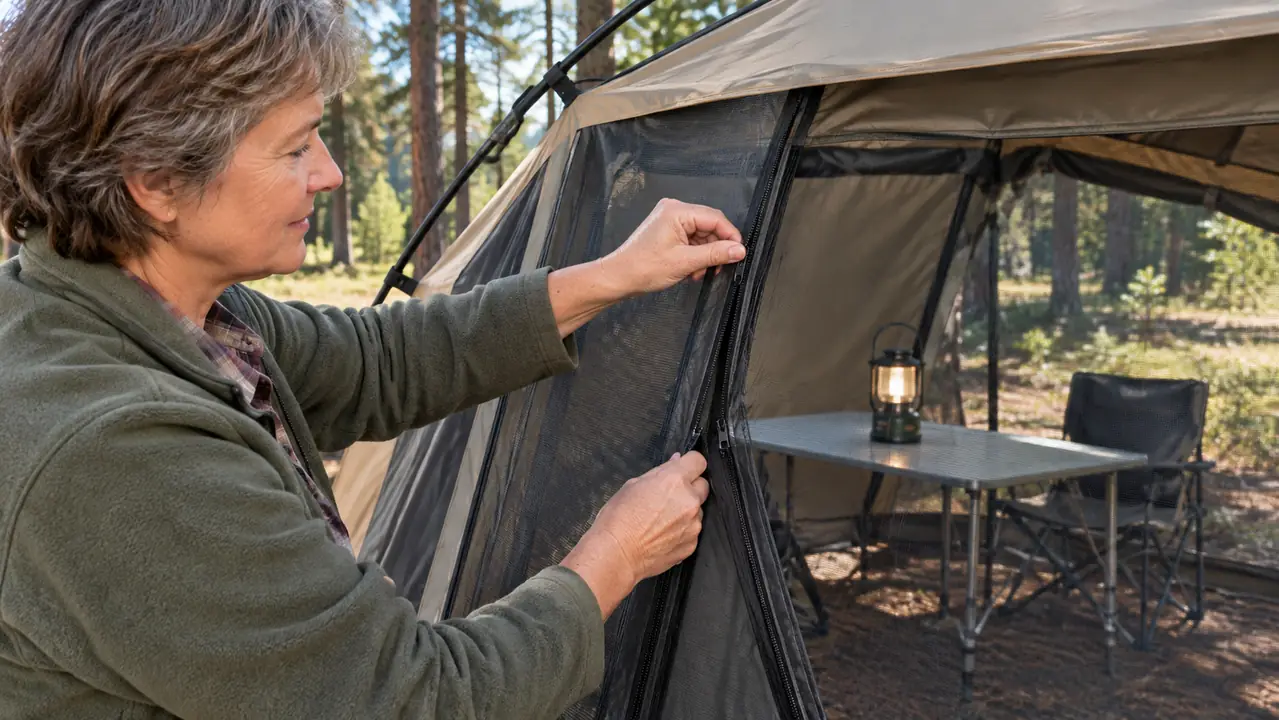
For anyone who has not seen one of these, the Alvantor is a pop up canopy with mesh walls and a roof of UPF 50 rated fabric. It is essentially a room you can stand up in, about the size of a small gazebo, with mosquito netting on every side so the air moves through but the bugs do not. The roof gives shade in the middle of the day and keeps the worst of the sun off the table.
The frame is the clever part. It is a set of connected poles that fold up into a flat disc, roughly the size of a steering wheel, that fits in the carry case. You pull it out of the case, give it a shake, and the whole thing springs open. The first time I did it I expected something to break. Nothing did. It locks into place with a little tug on each corner, and the whole process is under two minutes.
There is no floor, which I consider a feature. You set it up over dirt, over pine needles, over gravel, and whatever is under it stays under it. Sand falls through. Mud stays outside. We put a camp rug down inside and that is plenty. The tradeoff is that you are on the ground, so a little dust does get in, but I would take that over a floor that has to be swept out every morning.
Setup, the Real Version
The product page says instant setup, and for once the marketing is close to honest. The first time I opened it in the driveway it took me about four minutes because I fought the case. The case is a tight, flat package and you have to pull the shelter out of it the right way, with the poles folded together. Once I figured out that the zipper has to go all the way around before you pull, it got fast.
Now the whole thing takes about ninety seconds. Open the case, pull the shelter out, let the poles spring open, lock the four corners, stake it down. Ray does the tent poles in roughly the same time, which means the screen house is usually up first. Taking it down is the one part that still gives me trouble. Folding the poles back into a flat disc takes a specific sequence, and the first three or four times I had to have Ray help me get the last two poles folded. It is a learned motion, not an obvious one.
My right knee is the reason this matters. I fell on the Kachina Trail two summers ago and I do not kneel well anymore. The Alvantor goes up and down without kneeling, without reaching over my head, and without bending at the waist. Every pole is within arm's reach from a standing position. That alone would make me buy it again.
Wind, Rain, and the Honest Limits
A screen house is a wind sail, and pretending otherwise is how people lose gear. The Alvantor handles a normal breeze, the kind that kicks up at dusk, without complaint. I have sat through a monsoon gust that would have flattened a beach umbrella and it held, though I had staked all four corners and the two extra loops on the windward side.
The honest limit is a real storm. If the forecast says sustained winds over twenty five miles an hour, I take it down and put it in the car. The stakes that come with it are decent but not heroic, and the frame is light on purpose. Light means it can move. I have not had it blow over, but I have also never pushed it into a genuine storm. That is not a flaw, it is physics, and the manual says the same thing. Plan for the storm and this shelter is an easy call; leave it staked and walk away and you are gambling.
Rain is a different story. The roof sheds water fine and the mesh keeps the worst of the bugs out even in a drizzle. What it does not do is keep you dry in sideways rain, because there is no solid wall. We have eaten dinner in it during a light shower and it was fine. In a hard storm we move inside the tent, which is what a screen house is for anyway. It is a bug shield and a shade sail, not a second tent.
The Daytime Life of It
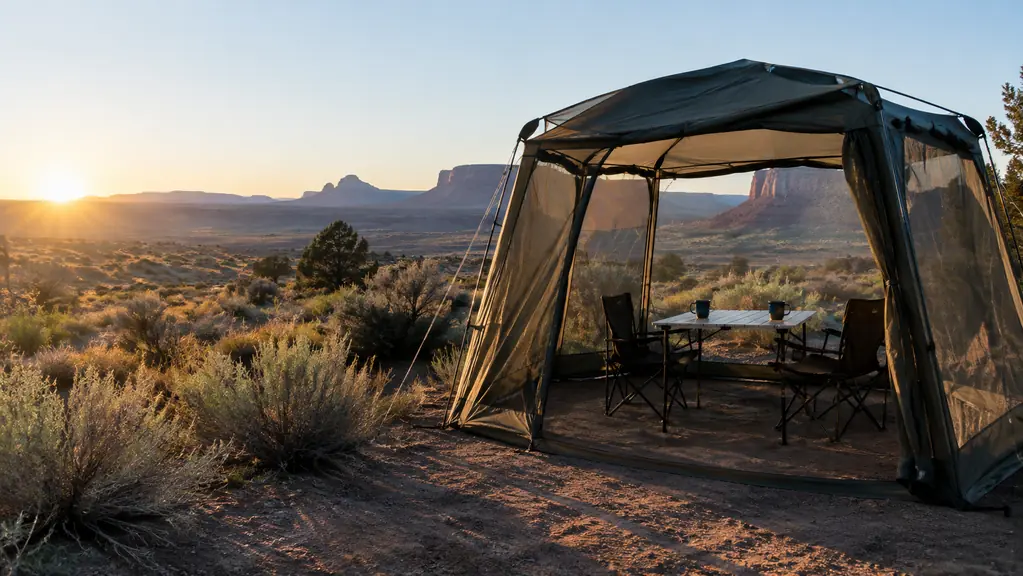
I bought the Alvantor for the bugs, but it earns its keep in the middle of the day too. The UPF 50 roof means we can leave the table set up under it and not worry about the sun ruining lunch or cooking us out of our chairs. On the one day trip where we set up a base camp for a long walk, the screen house was our shaded staging area all afternoon.
The mesh walls are the underrated part. On a warm afternoon the air moves through them and it stays noticeably cooler inside than out in the open sun. At dusk the bugs find the mesh and not us. And because there is no floor, I can sweep pine needles out with my foot instead of brushing out a tent. Little things, but they add up over a season, and they are the reason this shelter gets used every trip rather than left in the car.
The string lights I hang from the top bar are not part of the shelter, but the shelter is the reason they work. There is a ridge pole up there that takes a hook, and a whole evening's worth of light hangs from it. It turns the thing from a bug shield into the best room at the campsite.
What Wore Out, What Did Not
After twelve nights and roughly ten setups and take downs, the Alvantor looks the way you want gear to look after a season: used, but not beaten. The mesh is intact. The zippers still run smooth, which surprised me, because zippers are usually the first thing to go on this kind of shelter. The stitching on the corners where the stakes go through is still solid, and the poles still lock into place with the same firm click they had on day one.
The one thing that shows wear is the case. It is a thin nylon sleeve, and the edge where the shelter slides in is starting to fray a little. It has not torn through, and the shelter still fits, but I have started being careful with it. If the case ever fails I would buy a cheap duffel rather than replace the whole unit, because the shelter itself is the part that matters.
The frame has developed a bit of a rattle where two poles meet on the long side. It does not affect the structure and it only shows when the wind is up. I keep meaning to wrap it in tape and I keep forgetting. That is the whole list of complaints after a season, which I consider a strong report card.
What I Liked
- Sets up in under two minutes once you learn the case
- Genuinely bug-proof mesh; we ate dinner without swatting on nine of twelve nights
- UPF 50 roof makes it usable in midday sun, not just at dusk
- No kneeling or overhead reaching, which matters for a bad knee
- Stands up to a normal monsoon breeze when staked
- Holds up well after a full season of use
Where It Falls Short
- Carry case is thin and starting to fray at the opening
- Frame has a small rattle where two poles meet
- Not for sustained high wind; it is a wind sail by design
- Folding it back flat takes a specific sequence that is not obvious at first
- No floor, so dust does get in
After twelve nights out, the Alvantor went into the worked column of my notebook every single time. That is a short list.
Who This Is For
This is for car campers, plain and simple. If you camp out of bins in the back of a vehicle like we do, if your idea of a good campsite has a table and a chair and a place to eat without bugs in your coffee, this is for you. It is for the person who is past the age of wanting to fight with gear, who wants the mosquito problem solved in ninety seconds instead of negotiated all evening. It is for people who would rather read in the open air than hide in a tent.
It is also for anyone with a body that does not want to kneel. The whole setup happens from a standing position, and after my fall on the Kachina Trail that is the difference between using a shelter and leaving it in the car. If you have a knee or a back that objects to crawling around a campsite, the Alvantor removes that objection entirely.
Who Should Skip It
Skip it if you backpack, because it weighs too much and the case is too awkward to strap to a pack. Skip it if you camp in places with sustained high wind, where a solid walled canopy is the safer bet. And skip it if the idea of a pole that has to be folded in a specific order makes you angry, because there is a learning curve on the take down. None of those are the Alvantor failing. They are just the wrong tool for the wrong job.
The short version is this. I bought the Alvantor because I was tired of eating dinner in the tent, and a season later it is the first thing out of the 4Runner on every trip. It is not perfect. The case is thin and the take down takes practice. But it solved the problem I bought it for, twelve nights in a row, and that is exactly what I want from a piece of gear.
The first thing we set up, every single trip
Twelve nights, two states, one storm, and it is still the best fix for a buggy evening I have found. If you car camp, this earns its space in the back of the vehicle.
Amazon Check Today's Price on Amazon →